The Pack of Lone Wolves: Why Businesses Need an AI Framework, Not More Tools

Share this insight


We spoke to a COO recently who had discovered their staff had taken it upon themselves to set up six separate AI platforms across three departments (one of which was a personal subscription of an employee on their own credit card and registered to their personal Gmail address)!
No visibility over what data was going in or where the data was going. No visibility on what outputs were being generated or how they were being used. There was no ill intent in the employee’s actions, they were simply teams trying to move faster and using “AI” because they thought they had to.
It’s a story that is becoming more and more common and with the ongoing regulatory changes in the Australian market placing increasing accountability and personal risk on company directors…It’s also a story that is becoming more and more important.
In the rush to adopt AI, many businesses have ended up accumulating tools rather than building the structures needed to support them. The result is often fragmented workflows, inconsistent governance, duplicated costs, and growing security concerns.
The challenge now is no longer whether there is an AI tool that can help. It is building an environment where these systems can operate safely, consistently, and in alignment with the business itself.
The Cart Before the Horse: Forgetting the Fundamentals
Since the dawn of SaaS, mid-market businesses have become conditioned to solve operational problems by buying another platform. If there was friction somewhere in the organisation, the answer was often a 30 day trial and another subscription.
AI operates differently and it’s very important to understand the fundamental structural change between SaaS and AI.
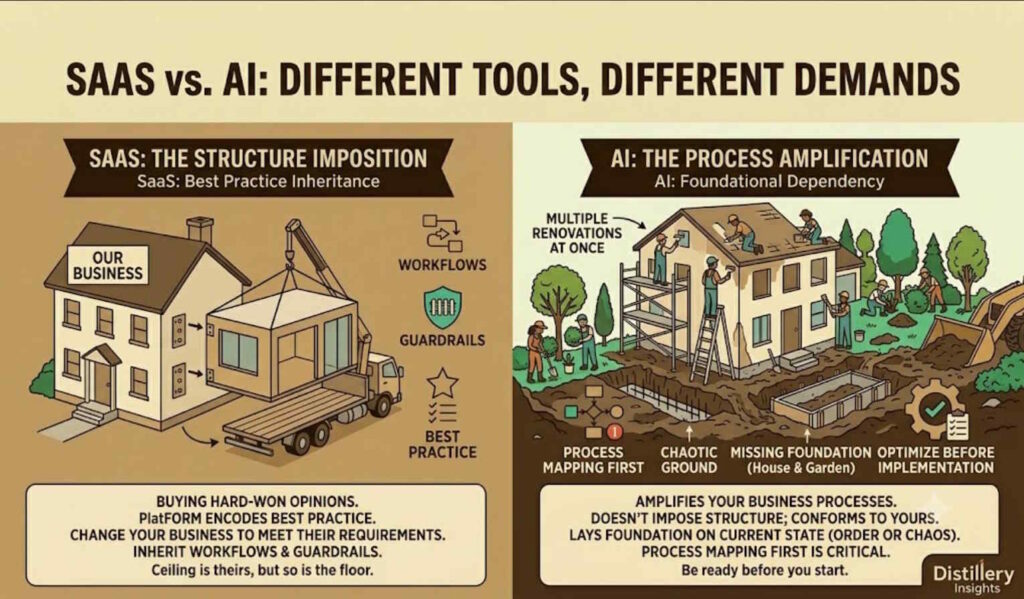
With SaaS, you buy the subscription and the business needs to align with what the provider offers, forcing the business to implement the proven processes and flows that the provider has laboured over.
Conversely, with AI, the tool molds itself directly to your business. In this scenario, the business forces the AI to conform with its existing processes and flows. Therefore, if they’re broken, then so is the solution that AI will deliver.
So this isn’t just another category of highly specialised software layered onto existing operations. AI changes how information moves through a business, how decisions get made, and how work gets executed. As a result, the good old “there’s a SaaS for that” mindset breaks down quickly.
Many of the organisations we work with are now discovering that AI accelerates a business’s natural change cadence to the level where it exposes operational problems that already existed at a rate greater than their capacity to rectify them.
If workflows are poorly documented, AI struggles to replicate them. If data isn’t consistent or fragmented, outputs become unreliable. If the business isn’t clear on what success actually looks like and what the business stands for, AI automation won’t deliver as much value.
The Fundamentals still matter.
Good processes. Clear ownership. Clean data. Defined governance.
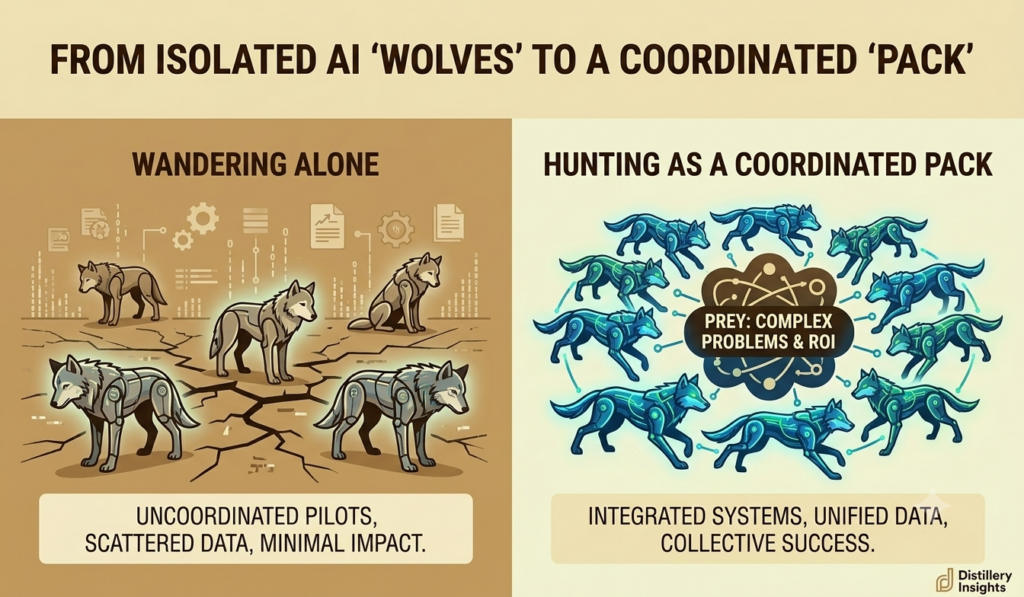
Without those foundations, businesses risk building a disconnected digital wilderness. Dozens of systems operating independently. No shared memory, no coordination, and no clear control structure. Lone Wolves wandering around your business.
The Shift: Teaching the Wolves to Hunt Together
Earlier AI adoption was largely centred around individual tools solving narrow problems.
The conversation is shifting toward orchestration, integration, and governance. In other words, how these systems work together inside the business. This matters…A lot. Large language models are powerful, but on their own they aren’t ERP’s (yet). They still need information, permissions, memory and clear boundaries.
Through working with numerous businesses on this journey, it’s becoming clear that the real value sits in the infrastructure around the models rather than the models themselves. We’re already seeing the first iterations of this approach:
Through products like Cloudflare’s Workers AI, Vectorize, and AI Gateway, businesses can now build routing and security layers around AI workloads instead of relying entirely on a single external model provider.
Microsoft’s new Microsoft 365 E7 Frontier Suite promises to securely connect much of the data in your tenancy and introduces centralised governance through Agent 365 alongside organisational memory and workflow grounding through Work IQ.
This is the start of a significant shift.
Instead of every department running isolated AI experiments, businesses are starting to gain visibility over which agents exist, what systems they can access, and how organisational knowledge is shared across them. The lone wolves are beginning to operate as a coordinated pack.
All this said, it is important to note that even the best control plane can’t fix broken operations underneath it. If workflows are poorly mapped, permissions are unmanaged, or data quality is unreliable, deploying autonomous AI agents simply accelerates the dysfunction.
As immortalised in the Anchor Man movie, you need to keep the question marks out of the teleprompter because unverified, low-quality data fed into an autonomous agent will inevitably output accelerated compliance disasters and potential public embarrassment.
The Dilemma of the Accelerating Horizon
New models, platforms, and capabilities are leapfrogging each other every few months. Leaders are worried about investing heavily in systems that may look outdated within their reporting cycle.
That concern is reasonable, but waiting for the market to stabilise represents its own risk.
Our experience indicates that the businesses gaining an advantage aren’t necessarily the ones spending the most money on AI tools. Often, they are simply the ones creating the clearest operational structure around them.
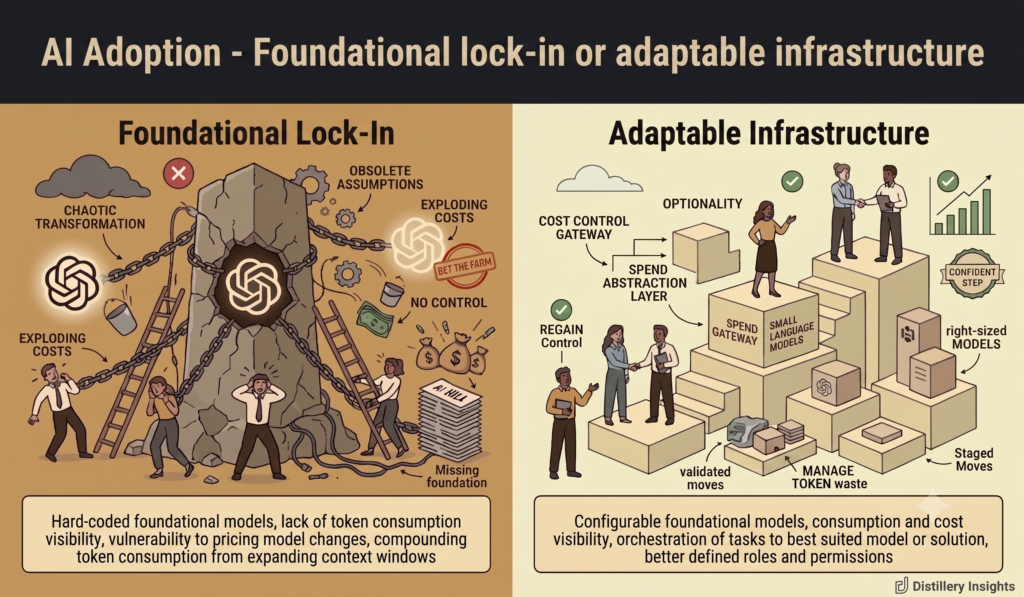
Flexibility matters more than trying to predict which individual model will dominate long term.
A business doesn’t need to make a perfect bet on a single AI provider. It needs an architecture that allows tools and models to evolve over time while keeping core business data, permissions, and governance under its own control.
Infrastructure decisions around security, workflow design, and data management tend to retain their value regardless of which AI vendor is leading the market six months from now.
Navigating the Wilderness: Where to Actually Start
The most appropriate first step is generally mapping out how work currently happens.
That sounds obvious, but many businesses still don’t have clear visibility over their own operational workflows, data ownership, or process bottlenecks. AI adoption exposes that very quickly.
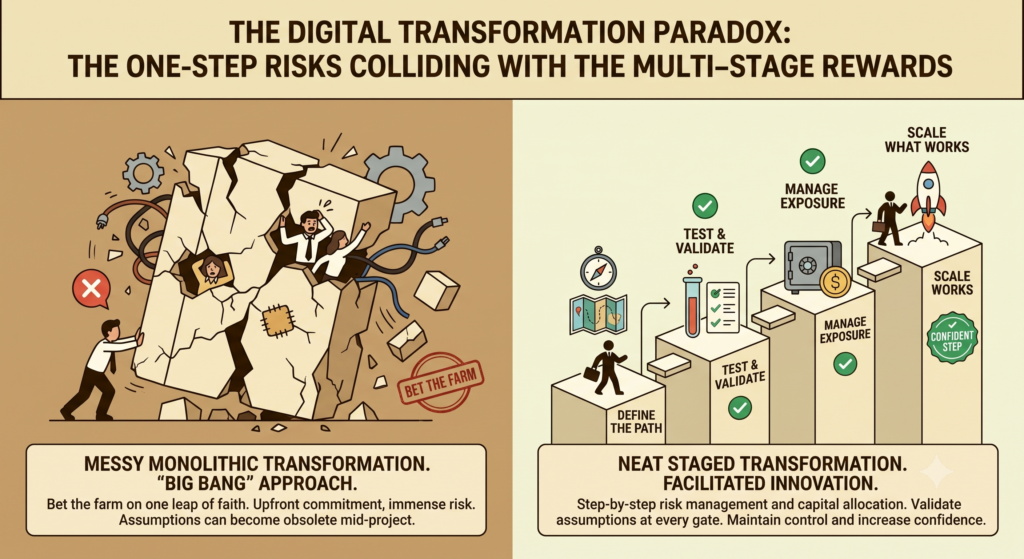
Our experience indicates that the strongest results are usually from taking a staged approach.
They begin with discovery work across operations, customer workflows, reporting systems, and internal processes. They identify where teams are losing time unnecessarily. They assess whether the underlying data is actually usable. They make sure that the team is getting the most out of the tools they’re already using. Then test small proof-of-concept projects before committing significant capital.
This is far less glamorous than the public conversation around AI, but it is where the real commercial outcomes are being created.
We recently worked with an accounting services company across its customer onboarding processes. Leads were falling through the cracks or stalling mid process, causing a sub-optimal experience for new customers. Their initial thoughts were to invest heavily in client-facing automation. After several weeks of detailed mapping, we realised they weren’t using their existing tools to their full potential and the larger issue was internal document handling between departments.
Instead of spending heavily on yet another system, we recommended redirecting the investment into fixing that operational bottleneck first. The improvement reduced onboarding delays substantially and delivered measurable conversion gains within the quarter.
Whether you are implementing AI or not, this approach is far more sustainable than trying to retrofit autopilot navigation on a leaky boat.
The Era of the Pack
The era of isolated AI tools (The Lone Wolves) will likely be short-lived.
If we fast-forward five years, the businesses that outperform won’t necessarily be the ones with the largest collection of subscriptions or the most experimental pilots running internally. Our sense is that they will be the organisations that successfully build secure, adaptable operational systems around AI.
In other words, the winners won’t be the businesses with the most lone wolves. They will be the ones that built the strongest, most cohesive pack.
That means environments where teams understand how AI is being used, where governance is clear, where workflows are documented, where security boundaries are enforced, where automation is linked to outcomes and where humans make final decisions will be the way forward.
The technology required to build those environments is already arriving.
The bigger question is whether businesses are prepared to do the foundational work needed to use it sustainably in the medium to long term.