SaaS vs AI: The Difference Most Miss

Share this insight


Treating SaaS and AI as the same type of technology can be an expensive mistake. While both have a legitimate role in a well-run business, they demand entirely different decision-making processes.
Here is the fundamental difference at a conceptual level, and why the sequencing of your deployment matters.
SaaS Imposes the Vendor's Structure; AI Amplifies Yours
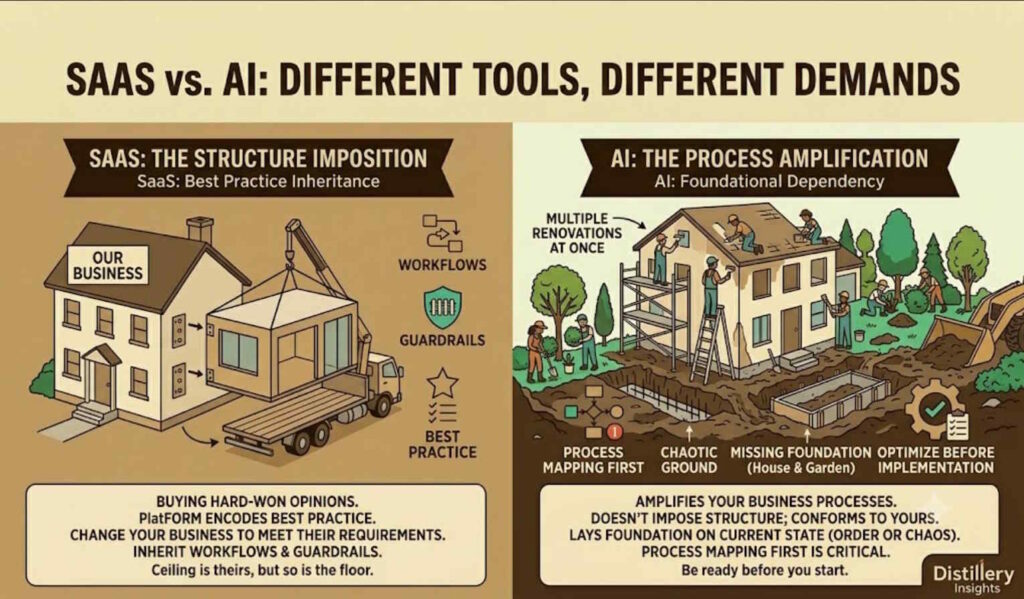
When you buy a SaaS platform, you are buying someone else’s hard-won opinion on how work should flow. A mature vendor has spent years encoding best practices into every workflow, guardrail, and default setting.
- The SaaS Approach: You inherit the vendor’s operational logic and adapt your business to meet their requirements. In a short amount of time, depending on the fit, your capabilities rise to a 7 or 8 out of 10. The vendor’s choices limit your ceiling, but they also limit the floor. That constraint is the entire point.
AI works almost in reverse. It does not impose a structure on your business; it conforms to yours. You define the processes, connect the systems, and the AI amplifies what it finds.
- The AI Approach: The promise of AI is to lift a sharp, well-documented process from an 8 to a 9 or 10. However, if your processes are broken, siloed, or inconsistent, AI will simply automate that chaos. You will not get better; you will just arrive at a 5. Albeit a very efficient and very quick 5.
Why the "Grace Period" Has Vanished
With SaaS, businesses often had the luxury to implement first and optimise later. The platform actively pushed back on institutional mess, forced users into standard compliance, and gradually pulled the organisation into shape. There was a built-in grace period.
With AI, that grace period often doesn’t exist.
AI won’t push back on bad data or fragmented logic. Instead, it will congratulate you on your insightful decisions and then build directly on top of your existing foundations, and accelerate whatever momentum (good or bad) already exists.
The key is to embrace what each offers and adopt the right decision making framework to leverage the strengths that each form of technology offers.
The Bottom Line
This is why rigorous process mapping must come before AI implementation, not after. You cannot connect systems first and hope clarity follows.
The critical mindset to adopt is to embrace what each of these technologies actually expects of their customers:
- SaaS expects you to adapt.
- AI expects you to be ready.
Understanding what a technology requires of your organisation before you sign the contract is the ultimate differentiator between achieving true scale or simply paying more to speed up the problems you already had.
Need help on your digital journey?
The Distillery specialises in innovation and transformation for mid-market companies in Australia. If you need assistance on your digital journey, please have a look at our Facilitated Innovation and Self Improvement Cycle methodologies and reach out for a chat.