Share this insight


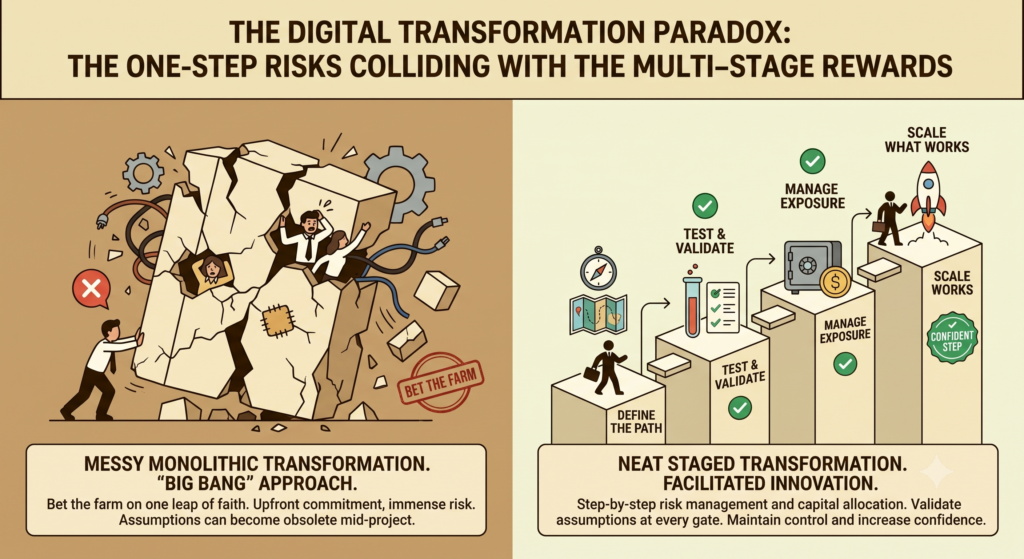
Your business might die if you don't transform. Doing it badly might kill the very thing you're trying to save.
Let’s be honest, it’s a particular kind of corporate purgatory. You know in your bones that your business needs to change. The talk of digital transformation, AI and innovation has gone from a whisper to a roar, in the market and in your own boardroom. The fear of being left behind is real, and it’s getting louder.
So the will to act is there. The budget might even be sitting in a spreadsheet, waiting. But “what next?” is a fog you can’t see through.
You’re staring at the chasm between where your business is and where you believe it needs to be. On one side, comfortable familiarity. On the other, the promised land of efficiency, growth and competitive advantage. The trouble is the chasm is deep, the fall looks expensive, and every expert is selling a different miracle cure. All you have to do is take the single biggest leap of faith in your company’s history.
That’s the Digital Transformation Paradox: the pressure to do something colliding with the monumental risk of doing the wrong thing.
Most transformation programs still ask you to bet the farm
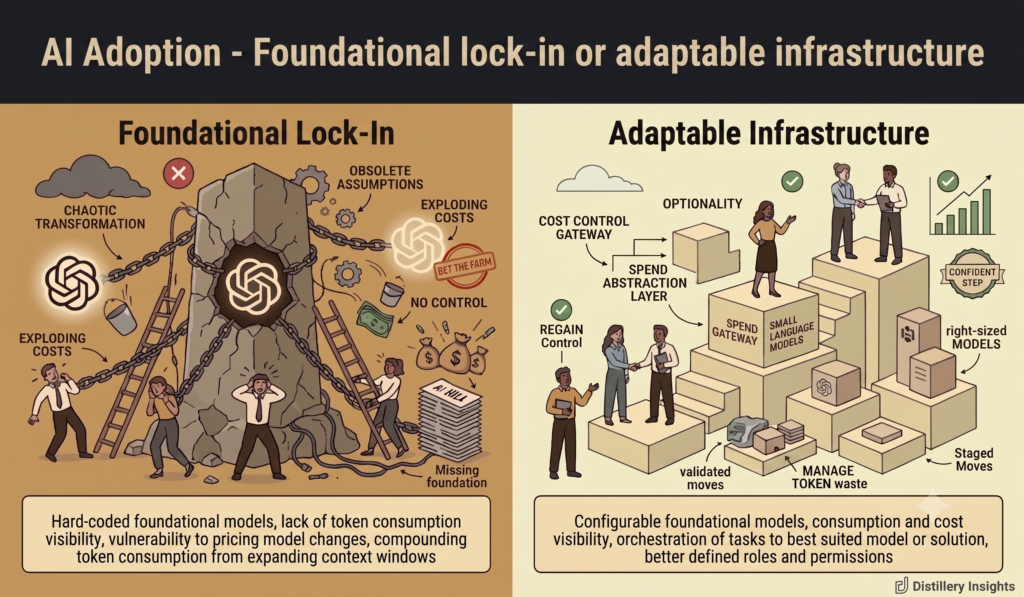
The traditional answer is the “big bang”: a multi-year, multi-million-dollar program that promises to fix everything at once. It needs a colossal leap of faith, a large upfront commitment, and the patience of a saint. You’re betting the farm on a single roll of the dice, on assumptions that may be obsolete before the project is even halfway built, in a market moving faster than any before it.
There’s a better way, and it isn’t complicated. You step into the fog and clear a small patch before you take the next step. You manage risk and capital through a series of confident, validated moves instead of one blind jump.
How it works: step down the risk, step up the confidence
We call this Facilitated Innovation, and it’s built for mid-market companies stuck in exactly this purgatory. It isn’t a product off a shelf. We design it around your desired outcomes, your available resources and, most importantly, your tolerance for risk.
The principle is simple. We break the journey into stages, and we treat each one as a gate.
- Define the path. Before a stage starts, we agree what success looks like, the metrics that will prove it, and the assumptions we’re testing. No guesswork.
- The go/no-go gate. At the end of each stage you have the opportunity, but never the obligation, to proceed. We review the evidence against the targets you set. Based on that, you decide to continue, pivot or pause.
- Managed exposure. As the unknowns fall, your confidence to invest rises. You’re not writing a blank cheque. You’re funding a series of small, well-defined experiments that build on each other, and you stay in control of both the project and your capital. No onerous contract.
A typical first step is a short, costed scoping stage, not a year-long commitment. You’ll know roughly what it costs and what it has to prove before you agree to it. That’s the whole point: the first decision is small, and every decision after it is better informed than the last.
At the end of the program you have real-world validation and the information to make a lower-risk call on what comes next. Engage us to build and scale it. Take it in-house or to another partner. Or decide not to proceed at all, armed with insights that turn a hard decision into a defensible one. The power stays in your hands.
Where this came from
This didn’t come out of a management-consulting textbook. The digital world moves too fast for that. It was forged in our venture studio, The Moonshine Lab, where we work alongside startup founders to validate a raw idea, raise capital and launch a business. It’s an environment where you do things that haven’t been done before: learn fast, fail fast, fix fast, repeat.
That position lets us cut our teeth on the latest experimental technology and work out what’s real, what has potential and what’s just hype. As those tools mature and our team gets their head around them, we bring them to our agency customers. We take the risk on the bleeding edge so you don’t have to.
What this looks like for AI
Right now, the bleeding edge is AI, and it’s where the paradox bites hardest. Every vendor in the market is promising efficiency. Almost none of them will tell you how to measure it in a way that means anything to your P&L. The gap between what’s promised and what’s provable is exactly where transformation programs come undone.
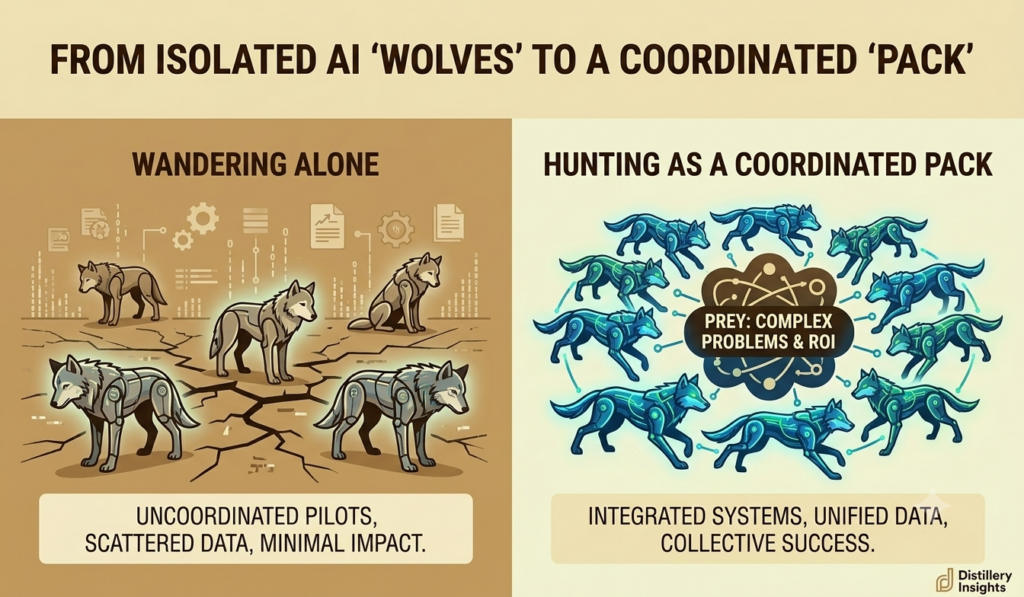
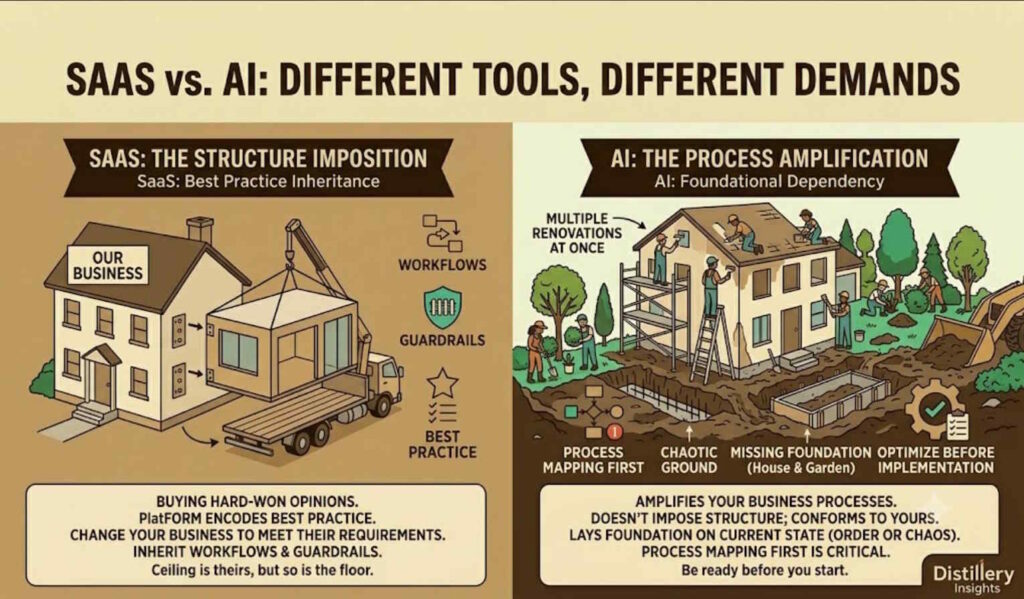
The problem isn’t the technology. Most of the current AI tooling is genuinely capable. The problem is that businesses are being pushed towards company-wide adoption before they’ve established what they’re trying to fix, what it costs them today, and what “better” actually looks like once they’ve got there and most importantly, laying down the right architecture and data foundations.
We apply the same stage-gate logic here. Before any AI experiment begins, we identify a single process where the cost of doing it manually is measurable and the AI alternative is testable. We baseline it: time, cost, error rate, whichever metric is honest about the problem. Then we run a contained pilot against that number. The gate question at the end of the stage is deliberately blunt. Did it move in the direction we said it would? If yes, we extend the experiment. If no, you’ve spent a small, defined amount to learn something true rather than a large amount to learn it far too late.
That discipline matters. AI efficiency gains aren’t guaranteed and they aren’t uniform. A saving in one process can be quietly offset by new costs in another if you don’t measure carefully from the start. The businesses that get real, durable value from AI aren’t the ones who moved first. They’re the ones who measured first.
How do we know it works?
Because we’ve done it a number of times in a number of industries. Since 2008 we’ve helped clients build genuinely new lines of business, not just trim a few costs. The OTR app began as a simple coffee-loyalty idea and grew into one of Australia’s most successful loyalty programs. MetroMate changed how South Australians plan public transport and set a benchmark for digital accessibility while it did it. Pavely changed the way people living with a disability can access the world around them and the St John’s lottery platform turned fundraising into a secure, scalable engine for a mission that helps save lives.
Across that work, our clients have generated more than $5 billion in new-business revenue. While we’re not going to share customer data, we’re happy to walk you through the publicly available information to show how that’s measured, because a number you can’t interrogate isn’t proof, it’s marketing.
The single confident first step
Transformation doesn’t have to start with a leap of faith. It can start with one small, costed, reversible step. If you’re tired of standing at the edge of the chasm, paralysed by “what next?”, let’s talk.