5 Questions Your Digital Transformation Partner Hopes You Won’t Ask

Share this insight


In 2026, the “Digital Transformation” market is crowded and not always by top quality providers. Most agencies, consultants, and software houses claim to have an “AI-first” methodology.
The stakes are higher than ever for mid-market companies: you have enough budget to build something transformative, but not enough to waste on a failed three-year roadmap.
Partners will attempt to wow you with slick demos of autonomous agents and predictive analytics. But the reality is not that simple. If you want to ensure your investment actually moves the needle on your EBITDA, you need to ask the uncomfortable questions.
Here are the five questions your prospective partner hopes you won’t ask and some suggestions on the answers you should be looking for.
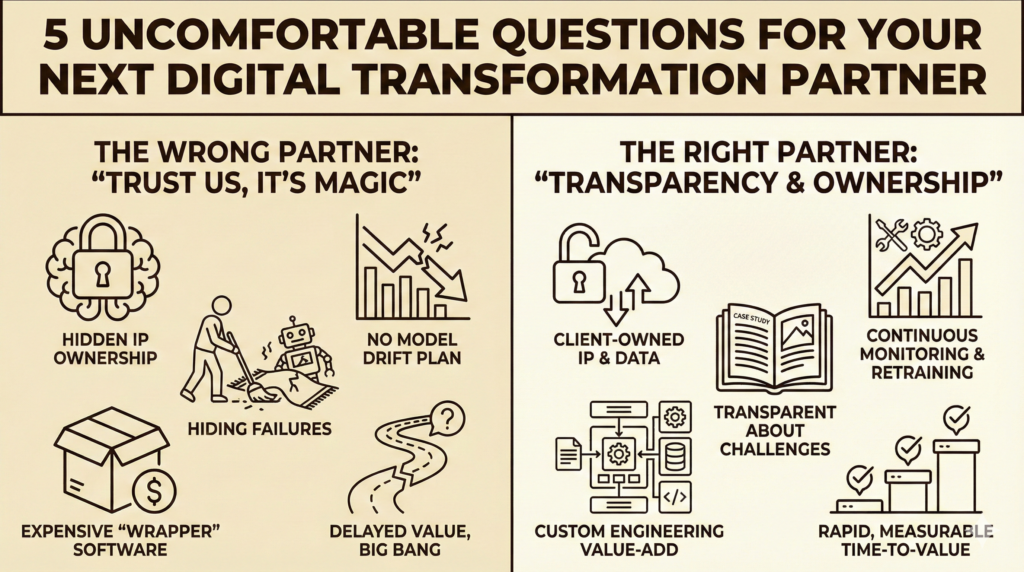
1. “Who owns the Intellectual Property (IP) of the ‘Brain’ we are building?”
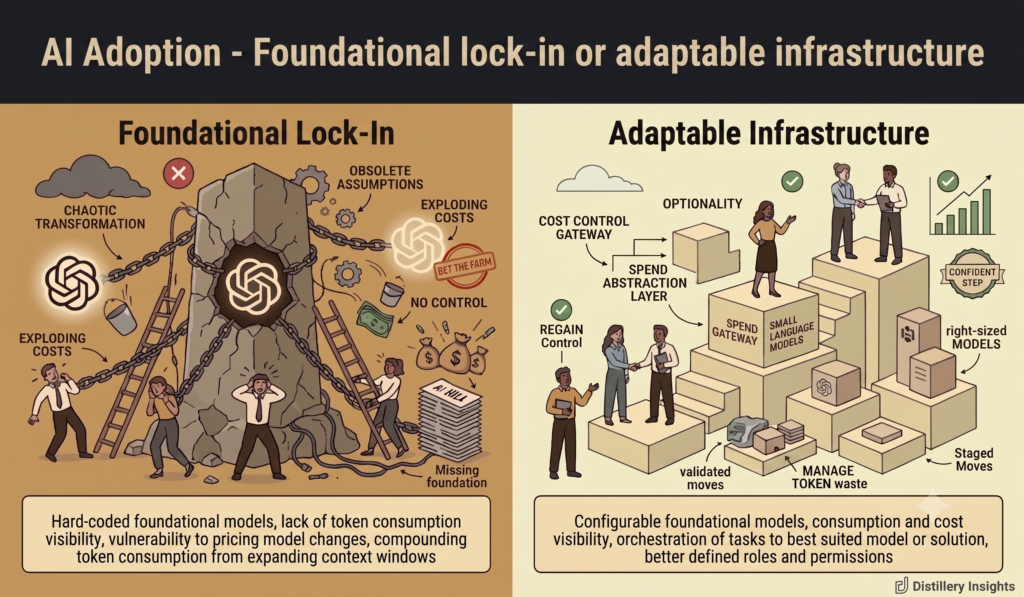
Many partners build custom layers on top of their own proprietary platforms. If you decide to leave that partner in two years, you might find that you don’t actually own the logic or the data pipelines that run your business.
- The Right Answer: “You own the code, the data schema, and the model weights. We build on your cloud environment (Azure, AWS, GCP) so you have total portability.”
2. “How does this solution handle ‘Model Drift’ once you’ve completed implementation?”
AI and digital workflows aren’t “set and forget.” In 2026, external market data changes rapidly. If a partner delivers a solution without a Maintenance Plan, your “innovation” may be obsolete within six months.
- The Right Answer: A clear explanation of their post-launch monitoring tools and how they handle the continual training / retraining of agents as your business data evolves.
3. “Can you show me a failed project and tell me why it didn’t work?”
The “everything is perfect” pitch is a red flag. Digital innovation is messy. A partner who can’t point to a project that went off the rails (and explain how they course-corrected) is likely hiding a lack of real-world experience.
- The Right Answer: A candid story about a scope-creep issue or a data-quality hurdle, and the specific structural changes they made to their process to prevent it from happening again.
4. “How much of this is custom engineering vs. expensive ‘Wrapper’ software?”
There is a massive trend of partners charging custom-build prices for what is essentially a thin wrapper around a public LLM (like GPT-5 or Claude 4). You shouldn’t pay premium rates for something your internal IT team could set up in a weekend.
- The Right Answer: A transparent breakdown of the architecture, showing exactly where the unique value-add (like custom RAG pipelines or proprietary integrations) resides.
5. “What is our ‘Time to Value,’ and what happens if we don’t hit it?”
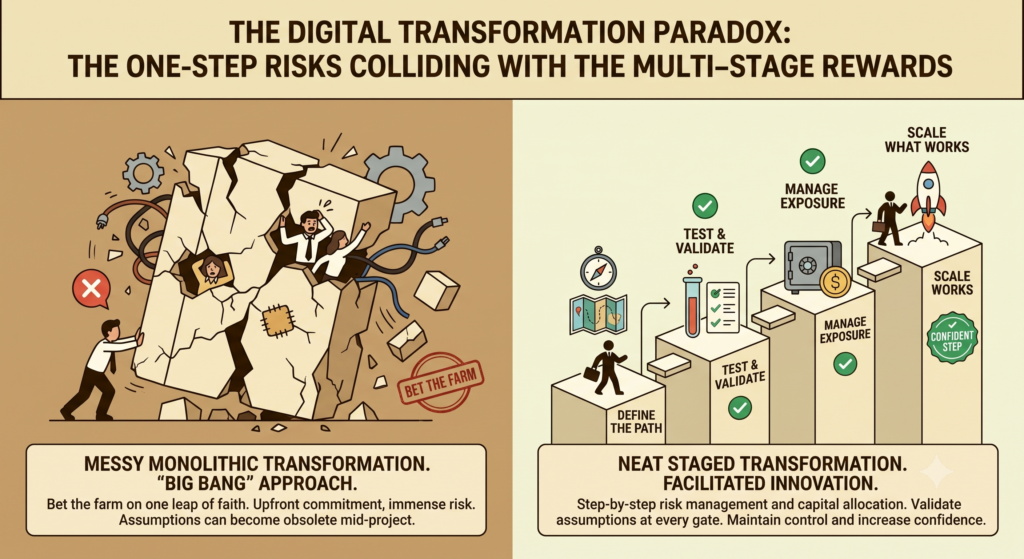
Mid-market firms can’t wait years for a “Big Bang” release. You need “Small Bangs” every 60-90 days.
- The Right Answer: A milestone-based roadmap with clear success measures that can be reported on in a reliable way and communicated easily to the relevant stakeholders.