The Mid-Market AI Advantage: Practical Wins You Can Achieve This Year

Share this insight


Why AI Is No Longer Just for Big Business
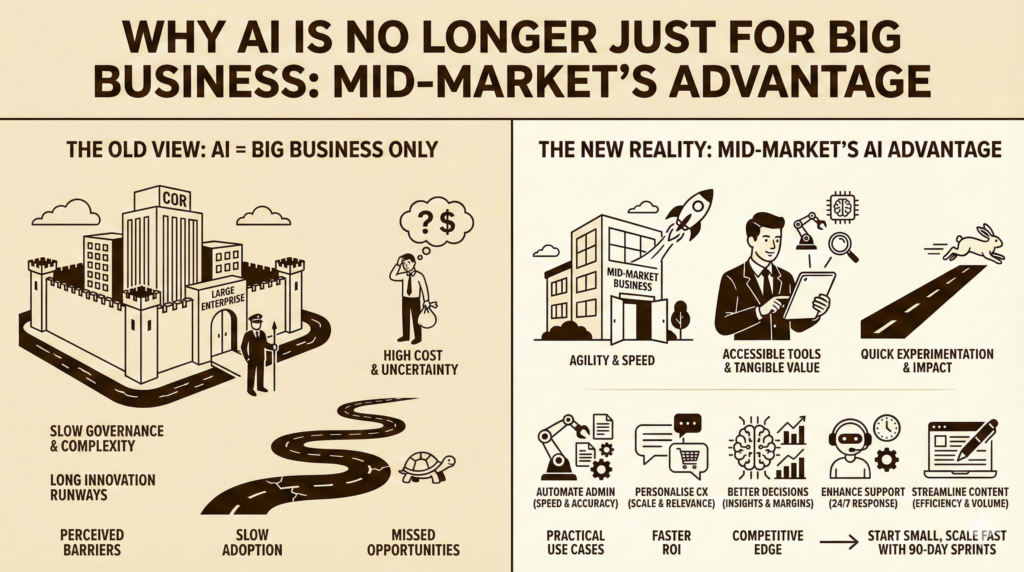
For many mid-market leaders, artificial intelligence still feels like something reserved for large enterprises with deep pockets, specialist teams, and long innovation runways. Until recently, that perception made sense.
Today, it no longer does.
Over the past two years, AI has shifted from an emerging technology into an everyday business tool. The cost of entry has dropped. The tooling has matured. And most importantly, AI is now delivering tangible, measurable value in practical areas of the business.
What often surprises people is that the organisations seeing the fastest returns are not always the largest. In many cases, mid-market businesses are better positioned to benefit from AI than their enterprise counterparts.
Why? Because speed matters.
Large organisations are often slowed by layers of governance, extended approval cycles, and complex change management programs. Mid-market businesses, by contrast, can identify an opportunity, test it quickly, and make a decision based on results rather than theory.
This agility creates a real advantage. AI rewards experimentation, iteration, and learning. The faster you can move from idea to impact, the faster the benefits compound.
The key is not adopting AI everywhere at once. It is identifying the right use cases and applying AI where it can remove friction, save time, or improve decision-making almost immediately.
Where Mid-Market Businesses Are Winning with AI Right Now
Across industries, we are seeing a consistent set of AI use cases delivering meaningful outcomes within months rather than years. These are not moonshot projects. They are practical improvements that free up people, sharpen focus, and improve performance.
Automating repetitive administration
Many mid-market businesses still rely heavily on manual processes for tasks like data entry, invoice handling, document classification, and approvals. These activities are essential, but they consume time that skilled staff could be spending on higher-value work.
AI tools can now handle these tasks with speed and accuracy, dramatically reducing manual effort.
In one example, a client used an AI-powered OCR solution to automate invoice processing. The result was a 60 per cent reduction in processing time, improved accuracy, and a finance team that could focus on analysis rather than administration.
Personalising customer experiences at scale
Customer expectations have changed. Buyers now expect personalised, relevant experiences regardless of whether they are dealing with a global brand or a mid-market business.
AI makes this achievable without expanding teams. Recommendation engines, behavioural segmentation, and dynamic messaging can tailor experiences across websites, email, and digital channels.
A retail client implemented AI-driven product recommendations and personalised email sequences. Without increasing marketing headcount, they lifted repeat purchases by 18 per cent in a single quarter.
Turning data into better decisions
Many mid-market organisations are data-rich but insight-poor. Valuable information sits across CRMs, finance systems, operational tools, and spreadsheets, but extracting meaning from it is difficult without dedicated analytics teams.
AI can analyse large volumes of historical data quickly, identifying patterns, trends, and opportunities that would otherwise remain hidden.
In one case, AI analysis helped a manufacturing business identify its five most profitable order types. This insight reshaped the sales focus, improved pricing discipline, and lifted margins by 9 per cent within six months.
Enhancing customer support
AI-powered chatbots and virtual assistants have matured significantly. They can now handle routine enquiries instantly, triage complex issues, and operate around the clock.
For a service-based organisation, implementing an AI assistant reduced response times from hours to seconds. Customer satisfaction scores increased by 23 per cent, while internal support teams were freed to handle more complex and valuable interactions.
Streamlining content creation
Content remains a major bottleneck for many businesses. Writing product descriptions, preparing campaign copy, and creating supporting assets all take time.
AI tools can now generate high-quality first drafts quickly, allowing teams to focus on refinement rather than starting from scratch.
A B2B organisation used AI to support campaign development and cut preparation time by half. This enabled the marketing team to launch twice as many targeted campaigns within a quarter, without increasing workload.
How to Capture the AI Advantage Without the Risk
The opportunity is clear, but so is the risk of getting it wrong. AI initiatives fail when they are too broad, poorly defined, or disconnected from real business outcomes.
The most successful organisations follow a simple principle. Start small, prove value quickly, and scale what works.
This is where mid-market businesses can outperform larger competitors. You do not need a sweeping AI strategy to begin. You need a focused, evidence-based approach.
Mid-market organisations can act faster because they can:
-
Approve pilot initiatives quickly
-
Integrate AI into existing workflows without long change programs
-
Measure ROI in weeks rather than years
That speed matters. It allows you to move from idea to impact while others are still planning.
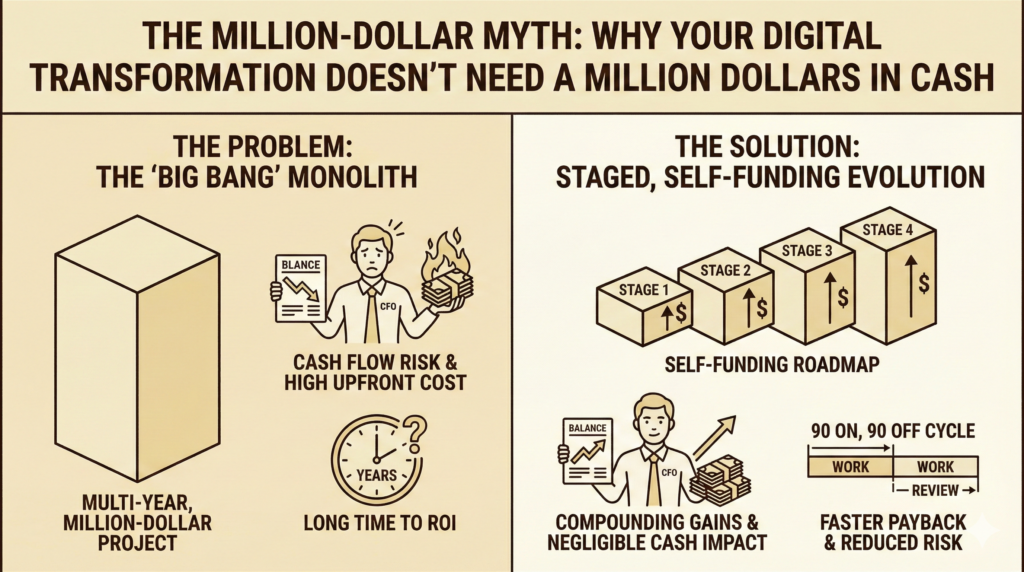
At The Distillery, we embed AI adoption into our 90-Day Transformation Sprints. This ensures AI is applied where it creates immediate value, not where it simply looks impressive.
Each sprint is designed to:
-
Identify the highest-impact AI use cases for your business
-
Test and measure results before significant investment
-
Build a repeatable framework for ongoing improvement
Rather than committing to large, uncertain programs, this approach delivers clarity, confidence, and momentum. You learn quickly, adapt based on evidence, and expand only when the value is proven.
The Bottom Line
AI is no longer the domain of tech giants or early adopters with large budgets. It is a practical growth tool for any mid-market business willing to apply it thoughtfully.
Over the next year, the organisations that embrace AI in focused, practical ways will:
-
Operate more efficiently
-
Deliver better customer experiences
-
Make faster, smarter decisions
Those advantages compound. And they compound quickly.
The question is not whether AI will affect your business. It already is. The real question is whether you will shape that change deliberately, or react to it later under pressure.
If you want to explore how AI could work for your business without wasting time or budget, the safest first step is to identify a small, high-impact opportunity and prove its value.
That is where real transformation begins.
Ready to explore your AI advantage? Let’s talk.