The Death of the “Productivity Gain”: Why 2026 is the Year of AI-nomics

Share this insight


For the last two years, mid-market companies have been in an experimental honeymoon phase with Artificial Intelligence. You’ve likely seen the pitch decks: “We’ll save 40% of our writers’ time,” or “Our customer service team will be 30% more efficient.”
In 2024 and 2025, those vague promises were enough to secure a pilot budget. In 2026, the honeymoon is over.
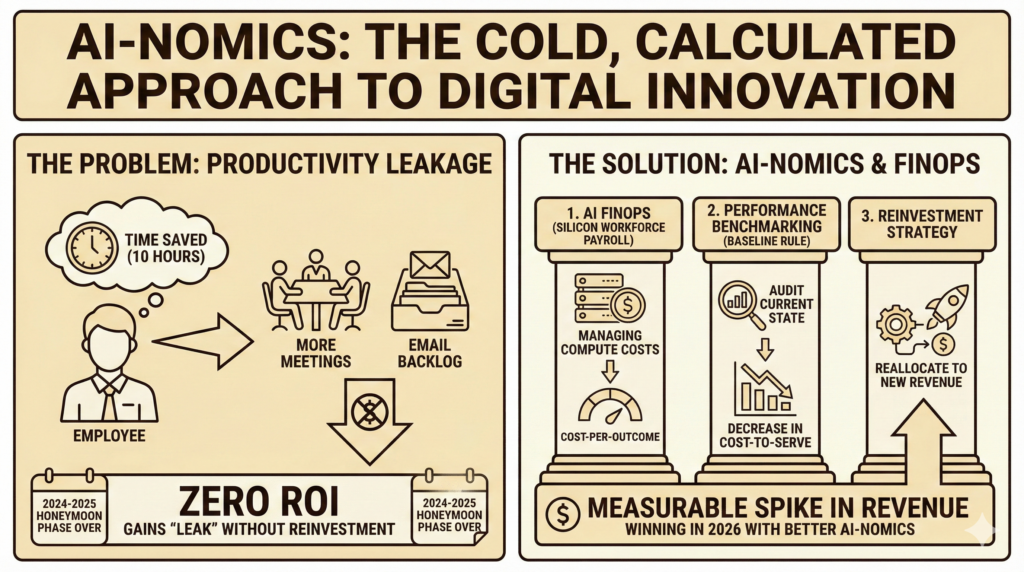
CFOs are no longer interested in “time saved” if that time doesn’t manifest as a reduction in OpEx or a measurable spike in revenue. We have entered the era of AI-nomics—a cold, calculated approach to digital innovation where “AI FinOps” is the only thing standing between a successful transformation and an egg-on-face write-off.
The Problem: The “Productivity Leakage” Trap
The biggest risk facing mid-market firms today isn’t that AI won’t work; it’s that the gains will “leak.” If an AI tool saves an employee 10 hours a week, but that employee simply spends those 10 hours in more meetings or clearing a non-critical email backlog, the ROI for the company is effectively zero.
Leadership is now demanding a bridge between efficiency (doing things faster) and leverage (doing things that scale the business). To get your next phase of innovation approved, you need to stop talking about “hours” and start talking about Unit Economics.
The Three Pillars of AI-nomics
To win in this landscape, your digital transformation should consider three financial pillars:
1. AI FinOps: Managing the Silicon Workforce
In 2026, your “Silicon Workforce” (agents and automated workflows) has a payroll. Every time an agent runs a task, it costs money in tokens, API calls, and compute.
- The New Metric: Cost-per-Outcome.
- The Question: Does it cost more to have an AI agent process a complex invoice than it does to have a human do it? If you can’t answer this, your “innovation” might actually be eroding your margins.
2. Performance Benchmarking (The Baseline Rule)
You cannot prove ROI without a baseline. Most mid-market companies skip the “boring” step of measuring their manual processes before they automate them.
- The New Metric: Decrease in Cost-to-Serve.
- The Requirement: A rigorous audit of current state response times, error rates, and labor costs before the first line of code is written.
3. The Reinvestment Strategy
Productivity gains are only valuable if they are reallocated. * The Strategy: If your marketing AI saves the team 100 hours a month, those 100 hours must be explicitly tied to a new revenue-generating initiative, such as launching a new product line or entering a new territory.
Three Questions You Probably Can’t Answer (But Your Board Will Ask)
If you are preparing for a 2026 transformation push, your prospective partners and your internal teams must be able to answer these three questions with data, not “vibes”:
- “What is our projected ‘Time to Break-Even’ on the initial implementation spend?” (If the answer is longer than 12 months, your architecture is potentially too heavy for the mid-market.)
- “How will we track ‘Productivity Leakage’ once the tool is deployed?” (Do you have the telemetry to see exactly where that saved time is going?)
“Is our AI infrastructure ‘Inference Optimised’?” (Are you paying premium prices for generic “GPT-wrappers,” or are you using smaller, cheaper, specialised models for high-volume tasks?)
The Mid-Market Reality Check
Mid-market companies have a unique advantage: you are large enough to have rich, proprietary data, but small enough to pivot your entire operating model in a quarter. Unlike the “Big 4” clients who spend millions on slides, you need to spend thousands on outcomes.
The companies that win in 2026 won’t be the ones with the most AI tools. They will be the ones with the best AI-nomics.
Are You Ready for an ROI-First Transformation?
Most digital transformation partners want to show you “what’s possible.” We want to show you “what’s profitable.”
If you are facing a decision on your next digital move and the numbers aren’t adding up, let’s talk. We specialise in helping mid-market firms innovate and transform with a built-in FinOps Framework.