Is your AI strategy missing the most important (but boring) first step?

Share this insight


The launches of AI products are starting to look more like movie premieres. The glitzy and glamourous stars (the algorithms), a massive budget, and the promise of a blockbuster hit that will change everything. Everyone wants to talk to take in the spectacle, but few seem to be talking about the unglamorous, foundational work of building the sets and writing the scripts.
And in the world of AI, that unglamorous, absolutely non-negotiable script is your data.
Whilst the market debates which AI model will revolutionise their business, you can get a massive head start by focusing on something far more fundamental. As I see it in our work with mid-market companies, the same principle applies whether you’re aiming for a full-scale AI transformation or just some smart process automation: the quality and breadth of your historical data will heavily influence your likelihood of success.
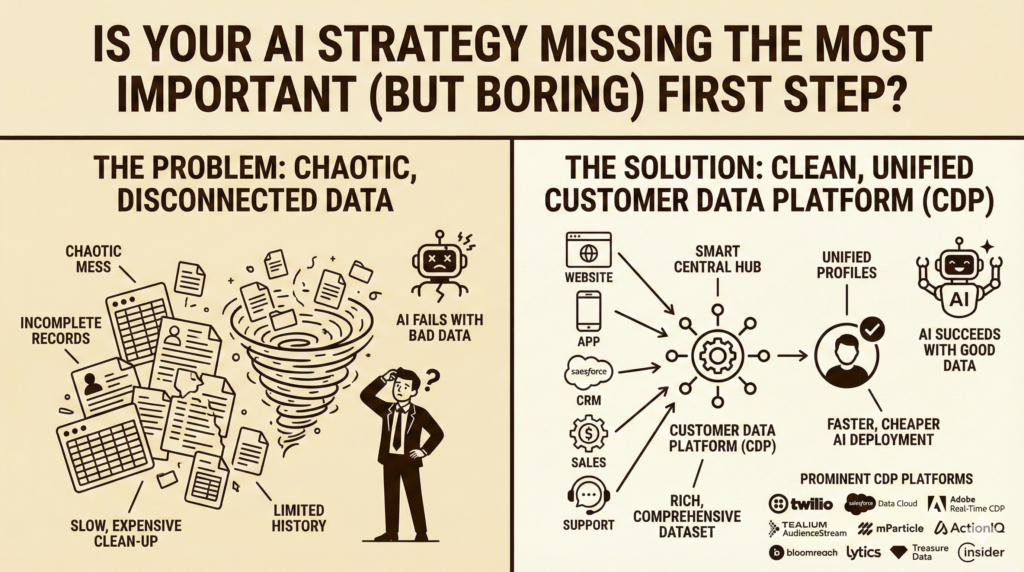
When it is time to deploy AI, it will need to be trained on a library full of YOUR books to get it ready to do work for you. If you hand it a chaotic mess of disconnected spreadsheets, incomplete customer records, and data that only goes back to last Tuesday, don’t blame the tool.
The Good News: Getting ready doesn’t have to be expensive
The fear is that “getting your data ready” sounds like a multi-year, seven-figure project that involves an army of consultants. It doesn’t have to be. For many businesses, the most powerful and cost-effective first step is simply evaluating and implementing a Customer Data Platform (CDP).
A CDP is essentially a smart central hub. It ingests data from all your customer touchpoints – your website, your app, your CRM, your sales system, your support desk – and unifies it into a single, clean, coherent profile for each customer.
Starting now, even without a grand AI roadmap, means that when the time comes, you’ll have a rich, clean, and comprehensive dataset ready to go. This will make your future AI implementation:
- Faster: You won’t spend the first six months just trying to find and clean your data.
- Cheaper: Your data scientists (or ours) can get straight to building valuable models instead of billing you for digital janitorial work.
- More Effective: Better data leads to smarter insights, more accurate predictions, and a genuinely better experience for your customers and staff.
To give you a starting point, here are some of the most prominent CDP platforms in the market. This isn’t an exhaustive list, but it covers a range of options suitable for different business needs.
| Platform | Core Strengths | Potential Weaknesses |
| Twilio Segment | Highly developer-friendly, huge number of integrations, excellent for real-time data collection. | Can become expensive as data volume grows; may be overly complex for simpler needs. |
| Salesforce Data Cloud | Deep, seamless integration with the Salesforce ecosystem (Sales, Service, Marketing Cloud). | Can be complex to implement; most valuable for businesses already heavily invested in Salesforce. |
| Adobe Real-Time CDP | Powerful for enterprise-level organisations using the Adobe Experience Cloud. Strong B2C focus. | High cost of entry; less flexible if you’re not within the Adobe ecosystem. |
| Tealium AudienceStream | Strong focus on real-time data and audience segmentation. Good compliance and privacy features. | Can have a steeper learning curve for non-technical users. |
| mParticle | Excellent for mobile-first businesses, with strong app data integration and privacy controls. | Focus is primarily on customer data for marketing and product, less on broader business data. |
| ActionIQ | Designed for enterprise business users to access and action data without deep technical help. | Primarily focused on large-scale B2C marketing use cases. |
| Bloomreach | Combines CDP capabilities with marketing automation and e-commerce personalisation. | Might be too feature-heavy if you only need a pure-play CDP. |
| Lytics | Uses its own data science models to help build audiences and predict customer behaviour. | Less flexible for teams that want to build their own custom models from scratch. |
| Treasure Data | Strong at handling massive, diverse datasets from across the entire business, not just marketing. | Implementation can be more complex and may require more technical resources. |
| Insider | An all-in-one platform that connects customer data to cross-channel campaign execution. | May not be the best fit if you already have established marketing automation tools. |
Don't Plan the Party, Just Buy the Ingredients
You don’t need to have your entire AI strategy mapped out to the nth degree. You just need to take the first, sensible step. Start collecting and organising your data in a clean, unified way.
When you’re finally ready to deploy AI, you’ll have an organised library, not a dumpster fire. That rigor can lay the foundation for meaningful innovation, genuine ROI, and helping lower the total cost of ownership for your digital future.
If you’re wondering how to take that first step, let’s talk about getting you ready for what’s next.