
Share this insight


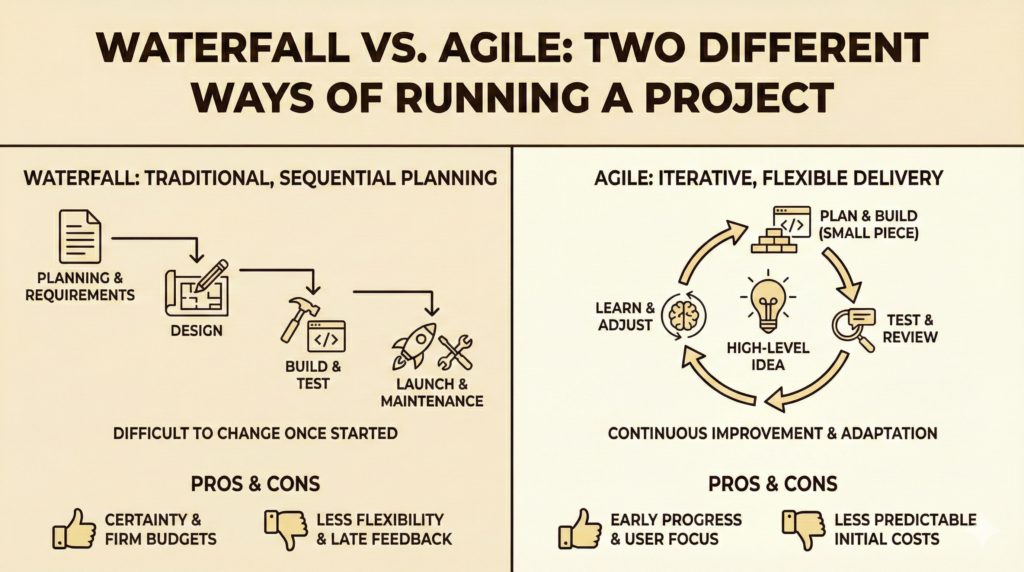
When people talk about Waterfall and Agile, they’re really talking about two different ways of planning and delivering work – especially projects like websites, apps, or digital platforms.
Waterfall is the more traditional approach. Everything is planned upfront. You decide what you want, how it will work, how long it will take, and how much it will cost before any real work begins. The project then moves step by step, like water flowing downhill—from planning, to design, to building, to testing, and finally to launch. Once you move past a step, going back is difficult and expensive.
Agile, on the other hand, works in smaller pieces. Instead of planning everything at the beginning, the team starts with a high-level idea and improves it bit by bit. Work is delivered in short cycles, with regular check-ins and opportunities to adjust based on feedback. The idea is to learn as you go, rather than trying to predict everything upfront.
Neither approach is automatically better. They are simply designed for different types of situations.
The Pros and Cons
Why Waterfall Can Work Well
Waterfall is a good fit when:
- You know exactly what you want from the start
- The project is unlikely to change
- You need firm budgets, timelines, and approvals
- There are strict rules, regulations, or sign-offs involved
Because everything is planned in advance, Waterfall gives a strong sense of certainty. Stakeholders know what they’re getting and when they’ll get it. This can be reassuring, especially for large organizations or projects where changes are costly.
The downside is flexibility. If priorities change halfway through, as they often do, you may discover that what looked good on paper no longer fits the business reality. Since feedback usually comes late in the process, there’s a higher risk of ending up with something that technically meets the plan but doesn’t quite meet user needs.
Why Agile Is Popular
Agile is often preferred when:
- Requirements are unclear or evolving
- The project depends heavily on user feedback
- Speed and adaptability are important
- The goal is to improve and refine over time
With Agile, stakeholders see progress early. Instead of waiting months to see a finished product, they can react to real results and guide the direction as the project unfolds. This often leads to better outcomes because decisions are based on actual usage, not assumptions.
However, Agile comes with trade-offs. It can feel less predictable at the beginning, especially around timelines and costs. It also requires active involvement, if decision-makers are unavailable or disengaged, Agile quickly loses its effectiveness.
Which one should you choose?
Here’s the honest truth: most real-world projects don’t use pure Waterfall or pure Agile.
Many teams blend the two. For example:
- High-level planning and budgets may be agreed upfront (Waterfall-style)
- The actual work is delivered in stages with regular feedback (Agile-style)
- Fixed deadlines exist, but the details evolve along the way
This hybrid approach reflects reality. Businesses want certainty, but they also need flexibility. They want control, but they also want results that actually work for users.
Instead of asking “Is Agile better than Waterfall?”, a better question is:
“What level of certainty do we have and how much change do we expect?”
If the answer is “We know exactly what we want and it won’t change,” Waterfall may be perfectly suitable.
If the answer is “We have a direction, but we expect things to evolve,” Agile is likely a better fit.
At the end of the day, these methods are just tools. The most successful projects aren’t loyal to a methodology. They’re focused on outcomes. Choosing the right approach, or a sensible mix of both, is less about trends and more about understanding your goals, constraints, and people.