A.I. – Just Because You Can… Doesn’t Necessarily Mean You Should…

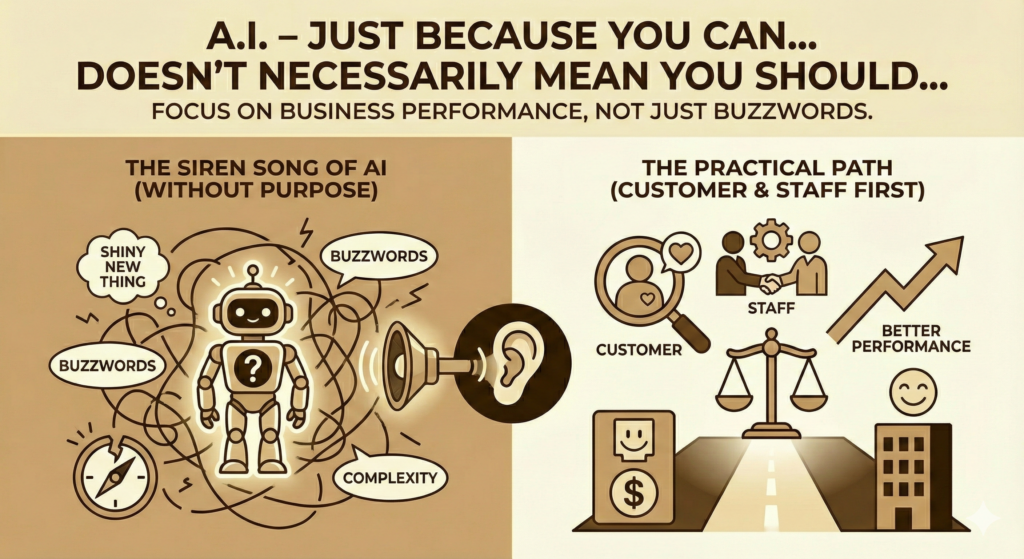
They say the road to hell is paved with good intentions. I’d argue it’s more likely paved with unnecessary software integrations and half-baked digital transformations.
I’m talking about the allure of the shiny new thing, the siren song of technology that promises to solve all your problems, only to leave you with a more expensive, more complex set of problems than you started with. And in this brave new world, there is no siren song more enchanting, no shiny thing more distracting, than AI.
The Distillery is a full service digital consultancy specialising in practical digital transformations and facilitated innovation for the mid-market and we have a slightly ironic view on the whole matter.
Our approach is less about the latest buzzword and more about the very un-shiny, but ultimately more profitable, realities of running a business. We believe the point of a business isn’t to cram as many buzzwords or acronyms into a board report as it can but rather to, you know… Treat your customers well, treat your staff well and as a result, in an utterly unsurprising turn of events, perform well.
It’s an almost unbelievably simple concept, yet one that seems to get lost in the noise of a thousand tech company press releases and a deluge of people coming to us and asking us for AI with the sort of determination and intensity normally only reserved for their morning coffee.
The reality is AI isn’t the reason they reached out. It’s just the excuse. They’re actually using it as a proxy for things like, “Why are my staff working harder than ever, but getting through less work”, “How can I stop my business from leaking money like a rusty colander?” or “Why are my customers fleeing to my competitors like they’ve seen a ghost?” Ultimately, business performance is the thing that keeps them up at night. The digital stuff, the AI, the cloud-based portals, the agents, workflows and chat bots…That’s just the means to an end. And let’s be honest…Most of the challenges were already there well before AI turned up.
The Golden Rule: Customers and Staff
Before we even consider a single line of code or a single algorithm or consider the use of even one AI token, we sit down and look at the real reason any business exists: the customer. What is the most mind-blowingly amazing product or experience you can give them? It’s a surprisingly simple question that unearths a wealth of learning. Customers are the oxygen of any business. Without them, you’re just a fancy building with a lot of expensive stuff, and your staff end up as people waiting for the next payroll until the music stops (or they just leave).
And speaking of staff…They are the second, equally crucial part of their equation. Once we’ve figured out what the customer wants, we turn to the staff and ask: “What is the best way we can help you achieve that?” Staff are the circulatory system of a business. They are the ones who turn the ideas into reality, who interact with the customers, and who, with a bit of help, can make the magic happen.
If you can get these two things right (a phenomenal customer experience and appropriately enabled and empowered staff) you’ve fundamentally got far more reasonable prospects for success. In fact, you’ve probably already lapped most of your competitors who are busy arguing about which chatbot or font to use on their new app.
The Inevitable AI Question:
It’s at this point that the AI question comes up. A client will reach out to us and ask, “So… Can we get some of that AI stuff? You know, the thinking machines? The robots? The agents?” Then, in the next sentence, they ask, “By the way what exactly is AI, and what can it do for me?”. It’s hard for them to tell the horse from the cart.
As mentioned earlier, the simple fact is that they’re not actually asking for AI. They’re asking for better business performance. They’re asking for a way to get ahead of the curve, a way to provide a better experience for their customers, a way for the CEO to improve their glassdoor score, and a way to make more money. Often, our first action is not to whip out a complex AI roadmap, but to be really boring and look at what a client already has. The tools, the software and the processes they’re already using. We’ll ask, “Are you squeezing every last drop of performance out of what you’ve already got?” More often than not, the answer is a resounding “no.” It’s amazing how much business performance can be improved by simply taking the time to do some research and teach people how to better use the things they already own.
After we’ve explored the effective options down that avenue, we then map out the business scope out its pain points and look at the market for tools, from AI to a well-placed spreadsheet, and ask the most important question of all: “What is the most appropriate solution for this specific problem?” And here’s the kicker, the dirty little secret the tech industry doesn’t want you to know: sometimes the answer isn’t AI. Sometimes, the most appropriate solution is a well-designed database, a better-trained team, or re-engineering a process so it doesn’t require three different people to sign off on a coffee order.
Meet the Intern:
All of this said, invariably, in this day and age there is a component of AI. So when we do recommend that AI is the right tool for the job, we make it clear that it’s not a magic bullet.
We tend to present AI as a new, entry-level employee, and a rather unique one at that. We personify AI as a diligent, voracious, and shall we say, slightly over-confident intern. It’s as smart as it gets, it learns fast, and it can do things you never thought possible, you can learn from it too, but it also needs to be told what to do, how to do it, and critically, how to avoid making a complete mess of things and equally importantly, it needs to be told how to keep secrets. You wouldn’t just hand a new intern access to the bank account on day one, would you? The same goes for AI.
So how do you do it?
In this article, I’m just presenting one view that is suitable in some circumstances and I’m doing it largely to present a different position to what I generally hear and read (Because it’s boring if we are all the same). Different types of businesses need different types of solutions. The Distillery generally works with SMB to mid-market clients, so we typically don’t go for a big bang, all-at-once approach. Whilst the big bang approach would be great for our business model and the prospects of that holiday in the Maldives I’ve been eyeing off, it’s often not fair on the client’s business, their customers or staff. We need to tailor the size and frequency of the meal to the size of the animal eating it to avoid indigestion.
We often recommend a staged rollout, often designed around a 90 on 90 off cadence. A 90-day project to deliver an outcome or two on the critical path, followed by a 90-day settling-in period where we evaluate, tweak, measure ROI and adjust. Then, we repeat the process. We’re in it for the long haul, a transformation journey, not a quick-fix sprint. We’re the responsible parents, not the fun-loving aunties who give the kids a massive sugar high and then leave (Hi Aunty Roli!).
And while many clients are cautious at the beginning (and understandably so), it’s actually no longer surprising to hear the same thing about six months after the transformation is complete: “Why the %^&$ didn’t we do this two years ago?”. It’s a bittersweet moment. On one hand, it’s validation that our practical, performance-first approach works. On the other hand, it’s a testament to the fact that sometimes, we get paralysed by fear of the unknown even when the most obvious solutions are undeniably a step forward from the current state.
So the next time you hear a tech company selling you AI as the solution to all your problems, remember this: the most important question isn’t “Can you use AI?” but rather, “Should you?” And the answer, my friends, is not always what you think it is.